
 By Mukesh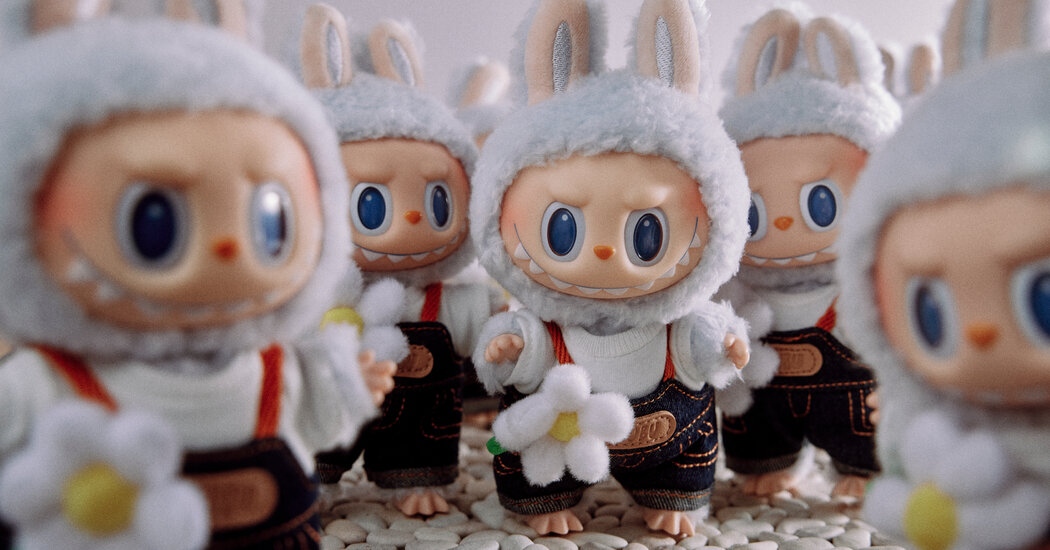
Over the past two years, a furry monster with bunny ears and a vicious line of serrated teeth became the subject of a global craze, as shoppers waited hours in line or paid hundreds or thousands of dollars for the most coveted Labubus.
The boom turned Pop Mart, the Chinese company that sells Labubus, into a global brand. But a test of the doll — the results of which The New York Times has independently confirmed — showed that clothing on certain Labubu dolls contains cotton from the Xinjiang region of western China, which the U.S. government has banned because of its association with forced labor.
For businesses like Pop Mart, selling products that contain cotton banned in the United States could have severe consequences. Companies found in violation of a 2021 law that restricts imports from Xinjiang can be put on a blacklist that bans all their products. The ban does not apply to importers that can prove goods were not made with forced labor.
A spokeswoman for Pop Mart said that it would conduct an investigation into the presence of Xinjiang cotton in its supply chains, and that the company held itself and its suppliers to “the highest standards.” Pop Mart said that only a small percentage of its dolls used cotton for apparel, and that it was working on a plan to use alternative materials, rather than cotton, in its products for the U.S. market.
Nonprofit groups have submitted information about Pop Mart’s use of cotton from Xinjiang and other alleged labor violations at its Chinese factories to officials at U.S. Customs and Border Protection, which would be responsible for enforcing an import ban.
The agency did not respond to requests for comment.
A test of the cotton in a Labubu was commissioned last year by the Campaign for Uyghurs, a Washington-based nonprofit that opposes the persecution of Uyghurs, a mostly Muslim ethnic group concentrated in Xinjiang.
That test was conducted in June by Testrigin Technology Center Limited, a product testing facility in Taiwan. Isotopes in cotton vary depending on where it is grown. The Testrigin lab found that samples from a Labubu doll contained cotton grown in Xinjiang.
The Times bought 20 Labubus that were listed as containing cotton late last year from various retailers and had them independently examined to identify the source of the cotton. The people who reviewed the dolls for The Times did not want to be identified because they did not have permission to speak publicly.
Pieces of clothing from 16 of the 20 dolls were identified as containing cotton from Xinjiang, mainly their T-shirts. The dolls themselves are primarily made of polyester, but the outer part of some of the dolls, including the clothes, are described as containing cotton.
The dolls that contained Xinjiang cotton were bought from Amazon, eBay, Shein, AliExpress and other retail channels, as well as directly from Pop Mart. They were from the Labubu lines called Fall in the Wild and Flip With Me. While counterfeit Labubu dolls, known as Lafufus, have proliferated online, each of the dolls tested contained a QR code that allowed The Times to verify it as an authentic product.
The Persecution of Uyghurs in China
A History of Tension For decades, the Chinese government has treated the Uyghurs, an ethnic group of about 12 million people in China’s northwestern region of Xinjiang, as a troublesome population with separatist tendencies.
With the wave of global interest in Labubus, the Chinese government has embraced Pop Mart as an icon of Chinese pop culture. Yet any potential legal violations by such a popular Chinese brand could be a test for the Trump administration, which has been wary of upsetting Chinese leaders before President Trump’s planned visit to Beijing next month.
A White House spokesman did not address the test results specifically, but he said the administration was monitoring for legal violations by importers and had initiated a broader investigation into the trade of goods made with forced labor.
Beijing denies any persecution of people in Xinjiang, where more than half the members of the population are part of Muslim ethnic groups. The government describes the programs it carries out in Xinjiang as poverty alleviation, as well as efforts to combat terrorism and separatism.
But human rights groups and journalists have documented evidence of forced labor, forced sterilization and heavy surveillance of people who are not Han Chinese, a majority in most parts of China.
In January, experts at the United Nations said they were concerned about a persistent pattern of alleged state-imposed forced labor involving ethnic minorities in China, saying the practice may amount to enslavement and a crime against humanity.
In 2021, Congress passed the Uyghur Forced Labor Prevention Act, which banned any product made in whole or in part in Xinjiang, unless the importer could prove it was not made with forced labor. The bill’s chief architect was Marco Rubio, a longtime critic of China, who was then a Republican senator and is now secretary of state. He has described the treatment of Uyghurs as genocide.
The law also established an “entity list” of companies in Xinjiang that use forced labor to mine or manufacture goods. That list has 144 entries, though no new companies have been added since the Biden administration.
Xinjiang produces more than 90 percent of China’s cotton, and about a fifth of the world’s cotton overall. Past investigations by The Times and others found Xinjiang cotton in the supply chains of many major retailers, though fear of penalties has led companies to adopt more rigorous vetting in recent years.
Liu Pengyu, a spokesman for the Chinese Embassy in Washington, said the Uyghur Forced Labor Protection Act was “one of the most notorious and egregious laws in the 21st century,” and “a tool for U.S. politicians to destabilize Xinjiang.”
Mr. Liu did not directly address the test results and the possibility that some Labubu products were in violation of the act, but he said China would defend the lawful rights and interests of Chinese companies.
Rushan Abbas, the founder of the Campaign for Uyghurs, said the group’s goal was to have Pop Mart products banned in the United States. Ms. Abbas, who is Uyghur American, works on behalf of the Uyghur population. Her sister disappeared in northwest China almost eight years ago.
The Labubu Boom
Despite making many of the world’s toys, couches and electronics, China has struggled to create its own coveted consumer brands. So the rising popularity of the ugly-but-cute Labubu — now the focus of a new feature film with Sony — has been a rare triumph for Chinese soft power.
The Labubu was created by a Hong Kong-born artist, Kasing Lung, who drew on a childhood fascination with the elves and trolls of Nordic folklore. In 2019, Mr. Lung began collaborating with Pop Mart, which had opened in Beijing as a variety store.
Pop Mart fueled interest in Labubus by selling the dolls in what are known as blind boxes, a format popular in China where consumers don’t know which doll they have chosen until they open the packaging. A Labubu generally costs $20 to $40 on Pop Mart’s website, though some fetch much more on resale sites.
Pop Mart has expanded in the United States through a mix of regular stores and “robo shops,” essentially Labubu vending machines. While most of Pop Mart’s business comes from China, revenue from the Americas rose more than 700 percent last year, accounting for 18 percent of overall sales.
Fans have included celebrities like Rihanna and Kim Kardashian and the tennis star Naomi Osaka, who made headlines at the U.S. Open last August when she showed off a Labubu-style doll that she named “Billie Jean Bling.”
But the Labubu boom may have started to fade. Despite its banner 2025, the company’s stock tumbled last month as it faced pressure to find its next hit product. It may face more challenges if its apparent use of Xinjiang cotton provokes a backlash.
Using information on the doll tags and boxes, The Times tracked the 16 Labubus that had Xinjiang cotton back to three separate factories in southeastern China that were operated by third-party contractors.
One of these factories sits in an industrial park in Jiangxi Province. China Labor Watch, a nonprofit, carried out dozens of interviews last year at the factory, which employs more than 4,000 people. In a report published in January, the group documented what it said were various labor law violations, including a lack of protections for underage workers and people working without proper contracts.
The spokeswoman for Pop Mart said it had carried out an independent audit of the factory after the China Labor Watch report.
Several lawmakers who were informed about the test results called for Labubus to be blocked from the United States. Representative John Moolenaar of Michigan, the Republican chairman of the House Select Committee on China, called the situation “unsurprising and unacceptable,” while Representative Ro Khanna of California, the committee’s highest-ranking Democrat, said it was evidence of the Trump administration’s failure to enforce trade laws.
“Pop Mart should prove that all of its dolls in the United States are slave-labor-free,” said Representative Christopher H. Smith of New Jersey, a Republican who is a co-chair for the Congressional-Executive Commission on China. “If they cannot, customs has the authority to stop all Labubu imports, and I will ask them to do so.”
The Uyghur Forced Labor Prevention Act has rarely been used against consumer companies, and never for a product as viral as the Labubu, said Adrian Zenz, an expert on Uyghur forced labor.
Under the law, if an interagency government panel reviews the evidence and finds that a company has violated the act, it can add the company to a sanctions list that would make it illegal to import any of their products. Customs officials can also detain the company’s shipments and demand an accounting of its supply chain, he said.
Xinyun Wu contributed research from Taipei.