
 By Mukesh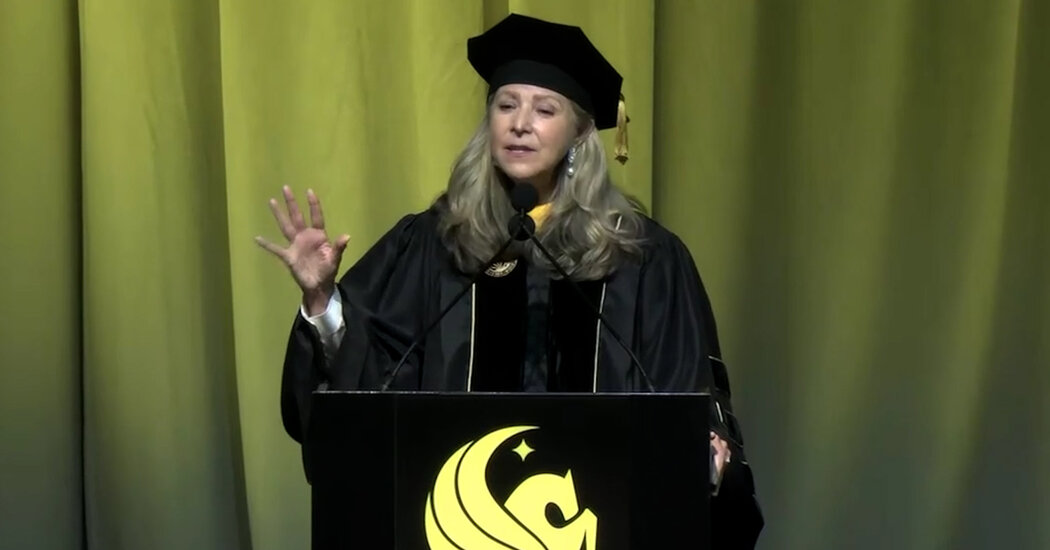
The purpose of a commencement speech is to uplift, inspire and embolden new graduates to go out into the world and attempt the impossible. But when the speaker gets it wrong, it can be a wet blanket.
That was the effect Gloria Caulfield, a real estate executive, seemed to have when she addressed the graduating class of the University of Central Florida’s College of Arts and Humanities and its Nicholson School of Communication and Media at a ceremony on May 8.
“The rise of artificial intelligence is the next industrial revolution,” she said, addressing a sea of black caps, gowns and tassels, most of them with newly acquired degrees in creative disciplines, including film, animation and media production.
The crowd booed.
“What happened?” Caulfield stammered, looking over her shoulder, as if searching for an escape hatch. “OK, I struck a chord! May I finish? Only a few years ago, A.I. was not a factor in our lives.”
The crowd erupted in cheers.
“And now, A.I. capabilities are in the palm of our hands.” Boooooooooo.
One might call it a “read the room” moment.
Ethan Lubin, 22, a graduate who earned his media production and management degree at the Nicholson School, was among the booers. “Talking about artificial intelligence at a college for arts and humanities can be, you know, a bit rough,” Lubin said in an interview, “because it kind of goes against the humanities part.”
Lubin, who is looking for a job as a video editor, is joining the work force at a time when generative A.I. threatens to render entry-level roles in creative fields obsolete. “A lot of us are worried that companies as of late have been using this sort of technology to replace artists rather than work alongside them,” Lubin said.
Earlier in the speech, Caulfield had lost some of the crowd by praising wealthy corporate leaders, including Jeff Bezos. It didn’t go over well.
“Using Walt Disney instead of Bezos would have felt generic to me, yet still demonstrated she understood she was speaking to a crowd of artists,” Max Pascual, 23, who graduated with a bachelor’s degree in fine arts that day, wrote in an email.
Caulfield, who is vice president of strategic alliances at the Orlando-based Tavistock Development Company, may have been trying to connect with young people by discussing new technology, perhaps harking to past eras of digital transformation. But she happened to do so in a perfect storm of a grim job market, A.I. fatigue and youth despair.
Requests for comment sent to Caulfield’s employer were not returned.
One might argue that Caulfield hit a nerve precisely because there is credibility to the inevitability of A.I. Some commenters online said that the A.I. genie would not go back into the bottle and that Caulfield was being penalized for speaking the truth.
“A.I. is an extraordinary tool that will forever transform our world, but it’s by definition unable to create a real-life story that hasn’t been told,” Modar Kajo, 30, a graduate with a film degree, wrote in a text message. “Some might argue that it’s naïve to proclaim that any job is A.I.-proof.”
But, Kajo added, “I’m still quite happy about my chances for the foreseeable future.”
A.I. was already a flashpoint for U.C.F. students well before Caulfield’s speech. In an article in April in The Charger, a student newspaper, the controversy over a class called “Art of A.I.” highlighted the concerns of students who feared they were being taught how to use the technology at the expense of developing technical and artistic skills.
These graduates’ views may be in line with what many of their peers are thinking. According to a survey released last month by Gallup, members of Gen Z and younger generations are growing more skeptical toward A.I.
Emkay Manfull, 18, a freshman majoring in graphic design at U.C.F., has sworn off using A.I. for ethical and environmental reasons. But she said she had felt pressured by the university to use it.
“There have been so many different teachers and classes and speakers throughout the whole semester, the whole year, that have been talking about A.I., and how everybody has to start using A.I. or else you’re going to fall behind,” Manfull said in an interview.
Toward the end of her speech, Caulfield struck a more conciliatory tone. “A.I., alongside human intelligence, has the potential to help us solve some of humanity’s greatest problems,” she said.
But for some of the young artists graduating that day, the sentiment rang hollow.
“From what I have observed from the people who push generative A.I., they do not understand that artists find the labor fulfilling,” Pascual wrote, adding: “There are so many intricate and deliberate decisions that are made when it comes to creating, many of which are pulled from an artist’s real life experience. An A.I. model has not lived or experienced anything.”
Alisha Haridasani Gupta contributed reporting.