
 By Mukesh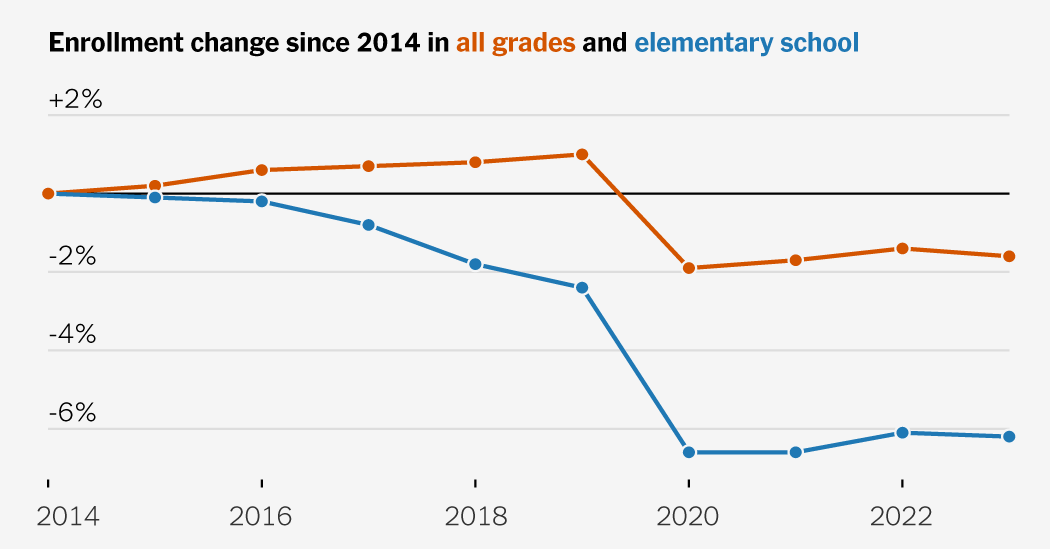
As American women have fewer babies each year, the number of young children in the United States is dwindling. The trend is now catching up to the nation’s public school districts.
There are simply fewer children to attend school in America today: The number of public school students in kindergarten through 12th grade has fallen in 30 states since the mid-2010s.
Declining enrollment has hit many of the nation’s largest urban school districts, including Los Angeles, Chicago and New York, a New York Times analysis found. But smaller and suburban districts are shrinking at a similar rate.
Fewer students means less funding, which is tied to enrollment numbers. Many districts are now facing painful budget cuts — and heated conversations about whether to close schools.
Several factors are affecting enrollment. Housing costs and other expenses are driving families out of cities. The recent crackdown on immigration means fewer children are arriving from other countries, a demographic that had buoyed enrollment.
Many public school districts also lost students during the pandemic, and are now facing more competition than ever, from private schools, home-schooling and virtual schools.
Data suggests that U.S. private schools had a small bump in enrollment during the pandemic, though it is unclear how much that has been sustained. This includes Catholic schools, where enrollment increased during the pandemic, but has declined overall over the last decade. Private schools are also set to benefit from new school voucher programs in many states, which help families pay for private education.
But experts say the biggest factor in declining enrollment is the record-low U.S. fertility rate. It most recently peaked in 2007, and has fallen 24 percent since then.
As children in that age cohort grow up — many babies born in 2007 graduated from high school in 2025 — there are fewer students to replace them. Projections from the National Center for Education Statistics, a research arm of the Department of Education, suggest that enrollment will keep falling in coming years.
“This year is actually the tip of the iceberg,” said Marguerite Roza, director of the Edunomics Lab at Georgetown University, an education finance research group.
In Portland, Ore., home to 44,000 public school students, enrollment has declined 9 percent since 2014. The main cause is falling birthrates, but Kimberlee Armstrong, the superintendent, said families are also leaving the city. The exodus began during the pandemic and has continued.
“People are choosing to raise kids somewhere other than in the city — moving to suburbs or places where they have access to affordable housing,” she said. “So it’s not just about losing students, it’s about the city of Portland losing families.”
The district is trying to sell itself with an enrollment campaign and by investing in pre-K and literacy, she said. But even though this year’s kindergarten class was larger than expected, “it doesn’t fix it long term.”
The district has a $50 million budget shortfall next year and is facing layoffs and school closures.
In Denver, school enrollment started to decline in 2020, the result of years of lower birthrates and high costs that pushed families out of the city. But then a surge in immigration between 2022 and 2024 brought several thousand new children to Denver’s schools, reversing the trend.
Now, immigration is down under the Trump administration, and Denver’s enrollment is declining again.
At Ashley Elementary School in Denver, which offers instruction in both English and Spanish, enrollment more than doubled to almost 400 students, from 175. Now, it is back down to 250, as migrant families dispersed elsewhere in the United States or returned to their home countries.
To fill a $674,000 hole in her budget, the principal, Janet Estrada, is cutting an assistant principal, a school secretary, a first-grade teacher and half of the school’s teacher’s aides for next year.
While there is less need with fewer students, the cuts can also mean fewer opportunities for the students who remain. She also had to cut an art teacher, and students no longer have a dedicated art class.
“I feel like a broken record trying to tell my community members, ‘It’s not Ashley, it’s not because of what we’re doing there, this is a national trend,’” Ms. Estrada said.
Even some affluent school districts that draw families because of high-performing schools, like in Palo Alto, Calif., and Montclair, N.J., have struggled to maintain enrollment.
Places defying the trend include rural areas on the outskirts of major metro areas, and states that gained population more broadly, like Idaho, Utah and Texas. Yet even those states have seen a dip more recently.
Americans have generally been moving from high-cost coastal states and Midwestern states to Southern and some Western states, and out of big cities, said William H. Frey, a demographer and senior fellow at the Brookings Institution. The pandemic accelerated these trends.
“People are broadly moving to where they can get an affordable house and a good job and their families are going to feel good living there,” he said.
That presents a challenge for the schools and students left behind.
A school with too few students still needs a principal, teachers and other key employees, resulting in a high cost per student. Often, schools cut electives or offer fewer Advanced Placement classes, which can push more families away.
Closing school buildings can save money — but be politically explosive.
So far, relatively few districts have carried out large-scale closures, in part because of political pressure from families. Some districts have faced criticism that closures would disproportionately harm minority and low-income students.
Still, closures may be on the horizon for more districts. Philadelphia and Austin, Texas, recently approved plans to close schools. In Oakland, Calif., where previous attempts to close schools have been vigorously opposed, more than 60 principals signed a rare letter supporting closures.
And in Pittsburgh, a plan to close nine schools was voted down by the school board in November, only to be put back on the agenda this spring.
“It’s necessary,” said the school board president, Gene Walker. The city’s public school system has lost about 25 percent of its enrollment in the last decade. One K-8 school has so few students it cannot offer algebra, he said.
Mr. Walker hopes to fix that under the new plan, which aims to bolster academic and enrichment offerings at remaining schools. For example, all elementary schools would offer art, music and a foreign language. Research has found school closures can hurt students academically, but students can also benefit if they are reassigned to a high-quality school.
“It’s better than looking our young people in the eye and saying we don’t have the ability to give you what you deserve, because we are not willing to make this really hard change,” Mr. Walker said.
Some demographers say U.S. fertility rates could rebound somewhat, if some young women today are simply delaying childbearing into their 30s and 40s. That happened before, in the 1970s, as women postponed pregnancy to pursue college and careers after the women’s movement. Some districts closed schools, then faced overcrowding when more children were born after all.
Still, districts like Pittsburgh may be left with little choice but to shrink, even if that means building new schools later.
“Even if it did rebound, you are looking at 10 to 15 years down the road,” Mr. Walker said. “If we wait another 10 to 15 years, I don’t know if this district survives.”
Emma Schartz contributed research.