
 By Mukesh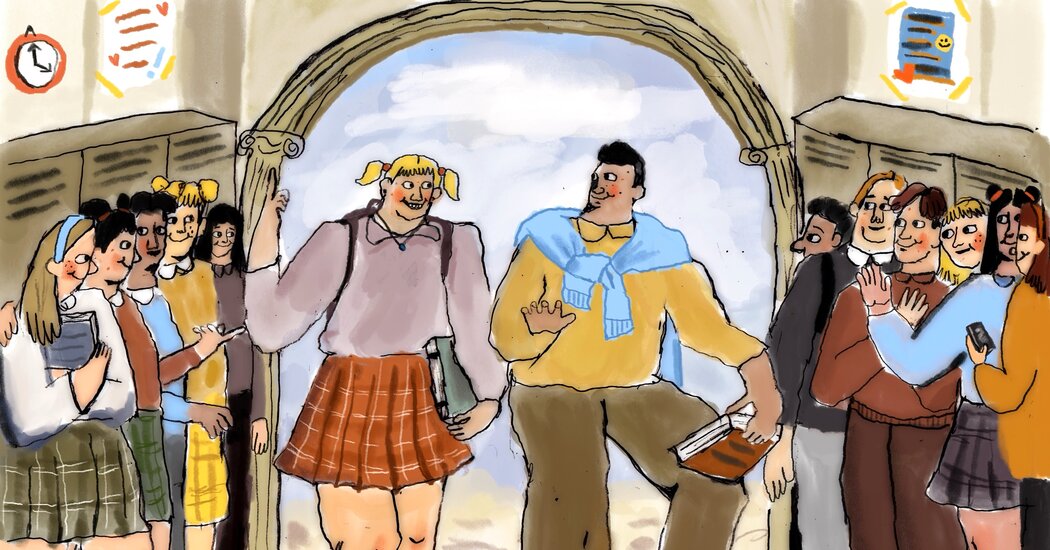
Having recently spent a year in public school classrooms for a book on civic education, I can tell you that the average ninth-grader does not sound remotely as serious, or as respectful, as the kids in Mr. Lemon’s class. Eagle Ridge is one of a growing body of classical schools whose traditional ethos includes both a curriculum based on the great books of the Western canon and a culture founded on the idea of virtue. That includes old-fashioned rules of comportment. Students at Eagle Ridge wear uniforms; younger students are expected to stand when speaking. The elementary school children enter and exit class in an orderly single file. I heard a kindergarten teacher, Paige Schneider, praise her kids for their perfect performance in the previous day’s bathroom break. “Raise your hand,” she said, “if you’re ready to commit to that again.” They were.
The idea that public schools should be used to impart virtue raises many hackles — not because we reject virtuous behavior, but because conservatives so often use “virtue” to enforce compliance with social codes. I share that unease: I’m a child of the 1960s who went to progressive schools where our chief extracurricular activity was protesting the Vietnam War.
But as the United States conducts a terrifying experiment in just how poisonously angry, distrustful and self-aggrandizing a democratic polity can become without destroying itself, we have to ask whether public schools should continue to regard the moral development of children as a purely private matter.
I was struck during my year in the schools by the growing wish for explicit moral instruction. Classical schools, both public and private, are growing rapidly across the country — of the 895 operating today, about one-third opened between 2020 and 2024, according to the Heritage Foundation. You can also see that hunger for a more moral education in the curriculums of some conventional schools. More than 90,000 middle and high school teachers now use materials from the Bill of Rights Institute, a nonpartisan nonprofit that lists nine civic virtues that, it claims, “promote self-government” and advance “the spirit of a common purpose.”
Perhaps our civic breakdown has made the case for moral clarity.
America’s founders, who disagreed on so much, never questioned the idea that a republic depended on the virtue of its citizens. They believed that the Roman Republic fell because the people became corrupt and that civic virtue had decayed in England under George III. They advocated widespread, even universal, systems of public schooling in order to reinforce the classical (not Christian) virtues of wisdom, justice, courage and temperance. Our first great school reformer, Horace Mann — an heir of the Puritan rather than the Enlightenment tradition — believed only the “common school” could make ordinary citizens worthy of self-government.