
 By Mukesh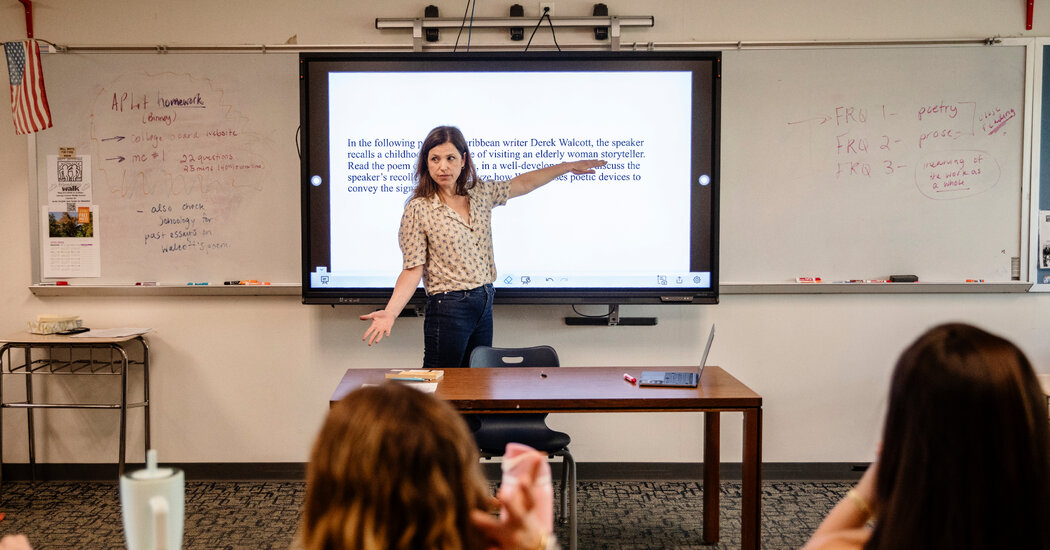
To the Editor:
Re “A.I. Prompting Writing Revival in Classrooms” (front page, May 3):
I read this article with empathy for fellow writing teachers and deflation for how my profession is meeting our current transformative moment with controlling rigidity.
More than 25 years in classrooms from China to Zimbabwe to the Bronx have convinced me that pen to paper can help us circumscribe our thoughts in ways a keyboard cannot. Yet to pretend that our students will not co-author with A.I. in every future professional context is myopic.
English teachers have always been innovators, pushing equity and justice into the curriculum to build a citizen body prepared to fight for a more ethical world. Why are we not taking up the cause of A.I. literacy?
I’ve been teaching my high school juniors at a school in the Bronx for over-age, under-credited youth how to co-author with A.I. while developing their agency and awareness. We learn how large language models work, where they cause harm and how to prompt them without losing our voice or our thinking.
Our challenge as English teachers is not to limit students’ use of technology but rather to teach them to maintain their sense of self in the face of what they think of as an answer machine.
K.A. Keener
New York
The writer teaches English at New Directions Secondary School in the Bronx.
To the Editor:
As a writing teacher long before A.I., I can assure you that A.I. is only the newest and most convenient method college students use to skip the tedious task of writing well. There have always been paid essay writers, and many used them, or students could pay a willing friend.
When I became a college writing instructor, I always required a short in-class assignment the first day. It takes only a paragraph to assess a student’s ability. Any brilliant papers submitted later were easily detected, and it was long before A.I.
Molly Larson Cook
Freeland, Wash.
To the Editor:
There is scant evidence that clear writing leads to clear thinking. It is the other way around: Clear thinking leads to clear writing.
Allen Berger
Savannah, Ga.
The writer is an emeritus professor of reading and writing at Miami University (Ohio) and a former editor of many education publications.
Trump’s Latest Assault on Science
To the Editor:
Re “Trump Fires Board Members of Group That Oversees U.S. Science Funding” (news article, nytimes.com, April 25):
Like many Americans, I was dismayed by President Trump’s abrupt firing of the more than 20 members of the National Science Board. This news was soon eclipsed when an armed man breached security at the White House Correspondents’ Association dinner the next evening. But the firings deserve more attention.
Established in 1950, the National Science Board oversees the National Science Foundation, which determines much of the funding for scientific research in the United States. By statute, its members serve staggered six-year terms, precisely designed to insulate them from the short-term vagaries of politics.
The round of firings is the latest attempt by the Trump administration to disrupt the role of science in the United States. In last year’s budget proposal, the administration proposed halving the National Science Foundation’s budget of almost $9 billion. Congress wisely restored almost all of the proposed cuts. The fiscal 2027 budget proposes similar cuts.
The United States’ place as the undisputed leader in science and technology is now being challenged by China and the European Union, precisely because federal support for basic science has eroded. Cutting support for basic research has been described as analogous to burning our seed corn.
Will Congress step up to protest? One may hope so, but the prospects seem bleak.
Frank Winkler
Middlebury, Vt.
The writer is a professor emeritus of physics at Middlebury College.