
 By Mukesh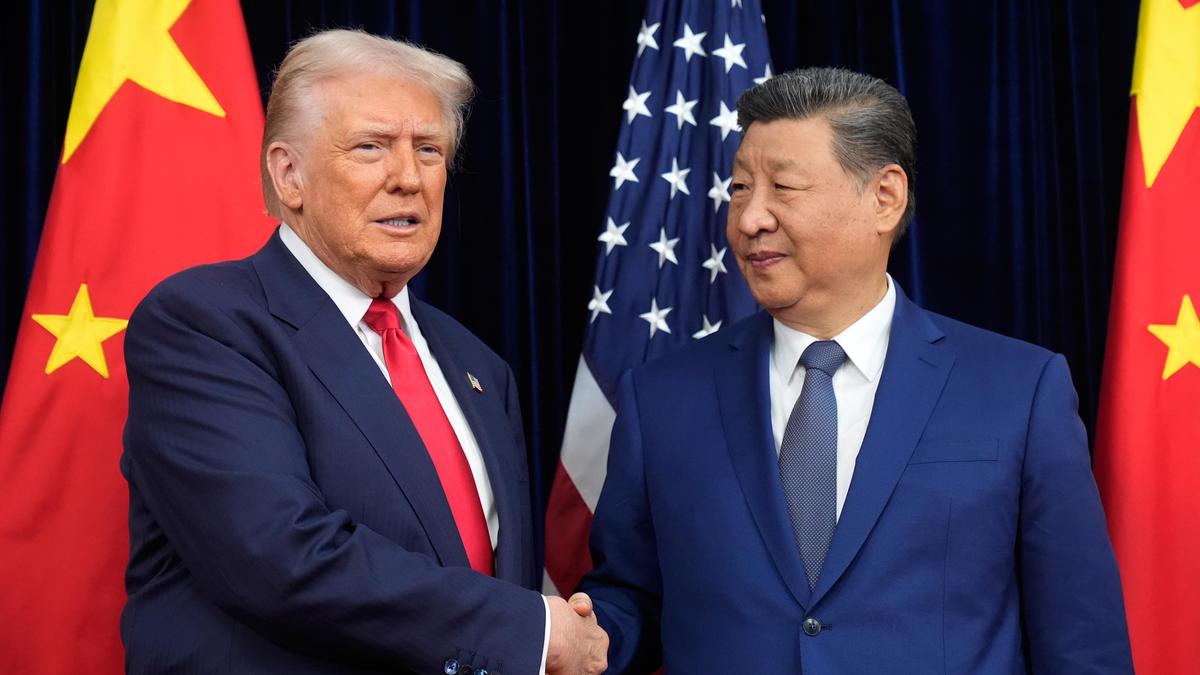

U.S. President Donald Trump had planned to arrive in Beijing in late March with a sense of swagger, on the back of what he thought would be two spectacular and swift regime changes in Iran and Venezuela.
Instead, as Mr. Trump on Wednesday lands in the Chinese capital, his hosts are debating the limits of American power and what “a declining U.S.” may mean for China’s ambitions.
The “three Ts” – trade, Taiwan and technology – are likely to garner attention during talks between Mr. Trump and President Xi Jinping set for Thursday (May 14, 2026) and Friday (May 15, 2026). During the three-day trip, Mr. Trump will visit the Temple of Heaven in Beijing and attend what was described as a lavish state banquet.
For Mr. Trump, progress on trade — including securing Chinese commitments to step up imports, especially in agricultural products, and greater access to critical minerals — is a priority. He will also look to pressure China to use its influence on Iran, U.S. officials said.

Mr. Xi will be looking for a reiteration of U.S. commitments on Taiwan and easing of export controls, particularly for advanced semi-conductors that China needs. Both sides are also expected to discuss Artificial Intelligence (AI) as an area of cooperation.
‘Stabilising anchor’
For both, some stability in ties is a shared objective. “I’m sure Taiwan will be a topic of conversation. It always is,” Secretary of State Marco Rubio said on May 5. “The Chinese understand our position on that topic; we understand theirs. And I think…both countries understand that it is in neither one of our interests to see anything destabilised happen in that part of the world. We don’t need any destabilising events to occur with regards to Taiwan or anywhere in the Indo-Pacific. And I think that’s to the mutual benefit of both the U.S. and the Chinese.”
China’s Foreign Minister Wang Yi similarly emphasised stability in an April 30 phone call with Mr. Rubio, saying meetings between the two leaders had been a “stabilising anchor” for the relationship. He called on both sides to “expand cooperation and manage differences, and explore the building of a strategic, constructive, and stable China-U.S. relationship.” He added that “the Taiwan question bears on China’s core interests and is the biggest risk in China-U.S. relations.”

Days before the visit, Mr. Wang hosted Iran’s Foreign Minister Seyed Abbas Araghchi, saying Beijing “supports Iran in safeguarding its national sovereignty and security” and that the “international community shares a common concern about restoring normal and safe passage through the Strait of Hormuz”.
Mr. Wang in his remarks did not criticise the U.S. for the war, as he might have ordinarily done, underlining Beijing’s keenness to set the stage for a visit that it has placed huge importance on. For Mr. Xi, hosting Mr. Trump, regardless of the outcome, is in some sense a success in itself, bringing with it valuable optics showcasing China, to the domestic audience, as a global power.
At the same time, for observers in Beijing, the visit comes at a time when the Iran crisis has only deepened their long-held perceptions of U.S. decline – views that acquired wide traction in the decade following the global financial crisis. “U.S. influence is increasingly contested,” as Peking University’s Wang Dong put it to The Hindu. “And its ability to impose outcomes unilaterally is declining.”
Long-term patience
A period of “intensified structural competition alongside constrained pragmatism” is how a briefing paper from two scholars, published on the eve of the visit by Tsinghua University’s Centre for Strategic and International Studies, described the future of the relationship.
A “competitive U.S. stance” on technology and supply chains was here to stay for the long term, it warned, but added that for the U.S., economic and domestic pressures would for any government “restrict comprehensive decoupling”.
Looking to the future, the paper said China needed to strengthen its relations with other major powers and continue its focus on innovation of key technologies as a response to U.S. policy. “China,” it concluded, “needs strategic resolve and long-term patience.”