
 By Mukesh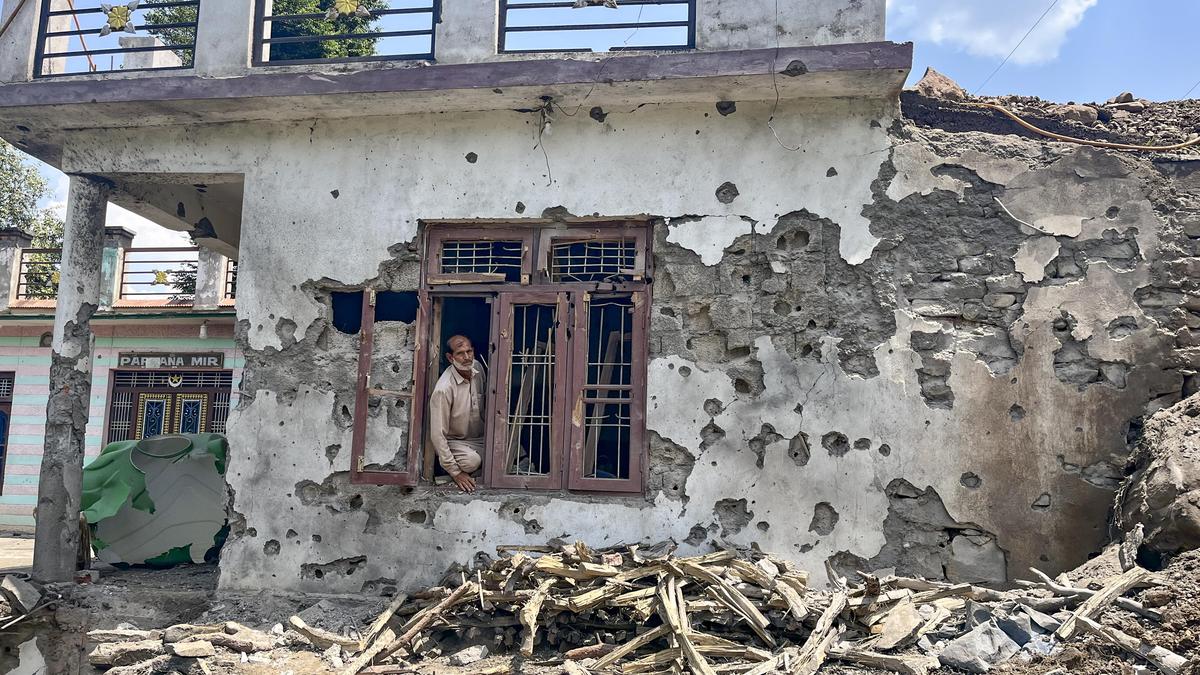
A year on, two schools in Jammu & Kashmir, which bore the brunt of the four-day conflict between India and Pakistan in May last year, stand testimony to the cost of war, tragedy, and trauma, staring at a long road to recovery.
Also Read | Operation Sindoor 2026 news updates
With Pakistan Occupied Kashmir (PoK) on the other side of the nearby hills, the Christ High School in Poonch is finding it hard bury the memories of the war. “Who would want a war that leaves children dead? In pursuit of justice for the Pahalgam victims, there was addition to the list of civilian deaths. War exposes the vulnerabilities of human beings,” Father Shijo, principal of the school for the past seven years, told The Hindu.
Three students – Zain Ali and Urwa Fatima, twins who were in Class 5, and Vihaan Bhargav of Class 8 – were killed in Pakistani shelling when they were trying to move to safer locations between May 7 and 11. They were among 21 civilians, including five children, who died on this side of the border during Operation Sindoor, launched against Pakistan following a dastardly terror attack that left 26 civilians, including 25 tourists, dead in Pahalgam.
“Parents of two Class 5 students were evacuating them out of their native village when a shell hit them. The third student was on the way to Jammu in a vehicle when splinters from a shell exploded and hit him,” said Mr. Shijo, as he recalled how the Poonch town was hit by shelling for at least two days. “I have never witnessed or experienced anything like that in my life,” he added.

On the first anniversary of Operation Sindoor on Thursday, the staff members of the school, with 1,500 students, held silent prayers for the dead and visited the two families for a remembrance meeting, but avoided any ceremonial function on the campus.
“We did not engage students in any remembrance because it would have recreated the scenes. It took students more than four months to come out of the trauma. We had to arrange local NGOs for counselling and chit chats with students to comfort them. We also invited the parents last year, many of whom broke down while sharing their ordeal, to make them unburdend emotionally,” said Mr. Shijo.
The school had to club classes and shut the rooms where the students, who lost their lives, studied. “Students were not willing to study in the same classroom, especially bench-mates of the deceased. At every sound of a cracker, students would get frightened. They lived in fear for many months,” said Mr. Shijo.
The school saw a major power shutdown during the war and relied on its borewell for water. Besides, the shelling shattered the windowpanes and damaged the roof. “We have rebuilt. In fact, we have an underground space in place, but can accommodate only 200 people,” he added.
Around 141 km away from the Poonch school, another school in Pulwama district tells a story of loss. The school was damaged in a blast, but since the nature of the explosion is still unknown, it does not fall in the compensation list of those who suffered damage in the conflict and were provided relief money. A two-storey building of the high school, Madrasa Taleem ul Quran, in Pulwama’s Wuyan was hit by an unidentified aerial object before sunrise on May 7. Locals said the administration neither provided any compensation for the loss nor revealed the cause of the explosion that ripped through the school building.
One year of Operation Sindoor | PM Modi says Indian forces gave fitting response to terrorism
“I heard in the morning of May 7, the school was hit. I rushed to check the damage but was stopped by the security forces. Later, I saw the computer lab was completely damaged. It has taken the brunt of the explosion. We acquired a children safety certificate from the education department only after dismantling the building first. It was not safe. However, no compensation was provided,” Shabir Ahmad Sheikh, coordinator of the school, told The Hindu.
Last June, the school sought financial assistance in the wake of ₹23 lakh loss incurred. “The school was hit by some aerial object. Revenue department officials visited the school and had assured to provide the financial assistance once provided with the estimation of the school building damages,” read the letter.
Mr. Sheikh said all expansion plans for the school, with 350 students, failed to take off because of the damage in the war. Local legislator Waheed-ur-Rehman Parra too wrote to the government for compensation but to no avail.
“Critical infrastructure such as the school building, computer and science laboratories, sports equipment, CCTV system, and a smart digital board were damaged in the incident. I strongly recommend that financial assistance be extended to the institution on a priority basis. The school has been serving local community with dedication and plays a vital role fur imparting quality education,” said Mr. Parra, in a letter to the administration.
With the nature of the blast yet to be established, the school awaits compensation to upgrade its infrastructure.