
 By Mukesh
In early 2026, users of Anna’s Archive — one of the world’s largest shadow libraries — woke up to find that the site’s domain had vanished. Within weeks, its alternative address was also taken down. For many students, researchers, and casual readers, it was a familiar disruption. For the organisations behind such platforms, it was business as usual.
Shadow libraries, or vast and often anonymous databases offering free access to books and academic papers, have long existed in a legal grey zone. For years, they were framed as a quiet rebellion: readers bypassing paywalls, students downloading unaffordable textbooks, teachers sharing educational materials, and knowledge circulating beyond borders.

In 2026, they are something else entirely. What was once an underground movement for access is now entangled in a much larger fight involving publishers, governments, and increasingly, artificial intelligence (AI) companies.
Platforms such as Library Genesis (LibGen), Z-Library, Sci-Hub, and Anna’s Archive collectively host or index tens of millions of books and research papers. Unlike physical piracy, which largely involves photocopied books or illegal print runs, these platforms offer high-quality digital files in multiple formats. Some operate as searchable indexes linking to files hosted elsewhere while others directly store massive collections.
Access appeal
The appeal of shadow libraries lies in access. In countries where books are expensive, libraries underfunded, or academic journals locked behind steep paywalls, shadow libraries fill a gap that formal systems have failed to address.
Messages left by users on these unauthorised platforms reflect this reality. A homemaker in Kenya described using Z-Library to build new skills while raising children. A reader in Lebanon said war and economic instability had made books unaffordable. A student in India credited Z-Library with making essential course material accessible.
While publishers and international authorities continue to fight back, digital piracy has proven far harder to contain than its physical counterpart. Websites go offline and reappear under new domains. Mirrors proliferate. Communities migrate across platforms. The infrastructure is decentralised, resilient, and often anonymous. Takedowns, while disruptive, rarely deliver lasting results.

The stakes change
In late 2025, Anna’s Archive drew global headlines after claiming it had scraped Spotify, collecting hundreds of terabytes of music and metadata. The move pushed shadow libraries beyond books and research into the realm of multimedia aggregation, hinting at a future where a single platform could host everything from literature and academic work to podcasts and music.
The legal response was swift. In January, a U.S. court ordered service providers linked to Anna’s Archive to disable access. Soon after, major publishers filed a lawsuit accusing the platform of operating as a commercial piracy hub and supplying content to the AI industry.
Another case added a new dimension. A group of authors alleged that Nvidia had used shadow library sources, including Anna’s Archive, to obtain copyrighted works for training artificial intelligence models. Nvidia denied the claim, stating that contact with the platform did not imply use of its data.

Regardless of the outcome, the implication is significant as shadow libraries are becoming potential data pipelines for AI systems.
This shift has unsettled even some supporters of the Open Access movement. While many users justify piracy as a response to high prices and restricted access, the idea of large technology companies benefiting from the same datasets introduces a new ethical concern.
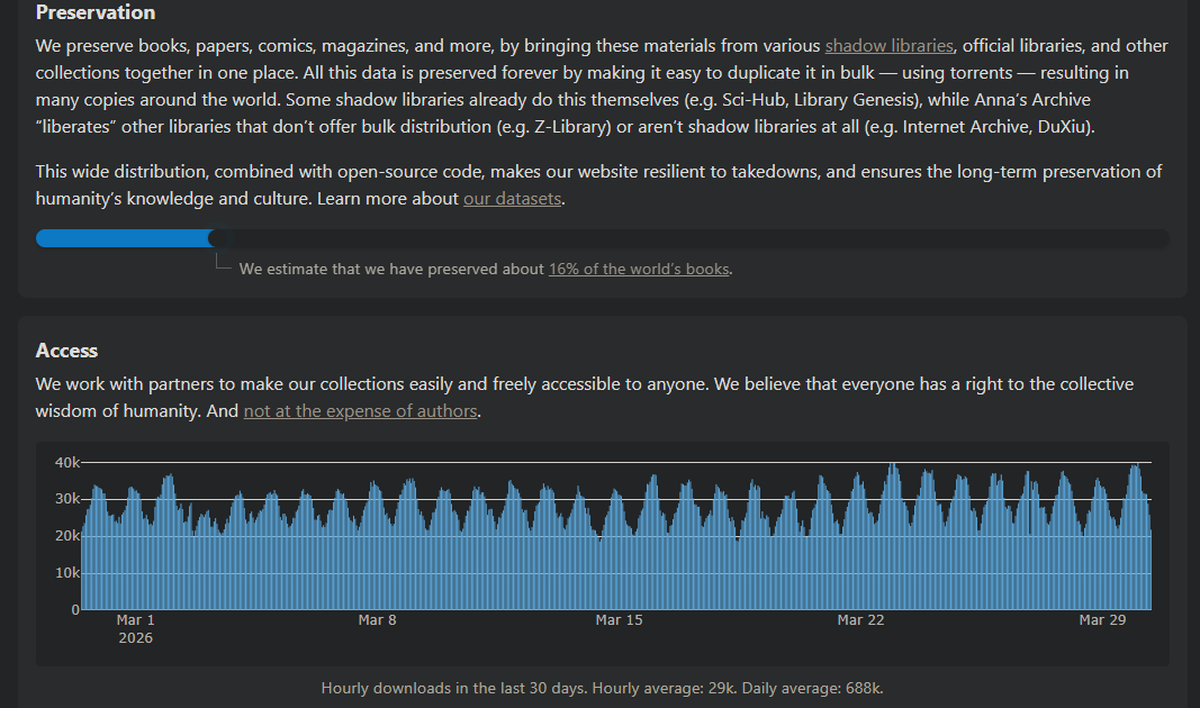
Anna’s Archive recorded tens of thousands of downloads on an hourly basis in March, per its data
| Photo Credit:
Anna’s Archive
Unequal access
Such concerns are enabling new open access systems that expand access to knowledge through legal channels.
“What distinguishes India is the continued and significant role of public-sector-led Diamond Open Access, where neither authors nor readers pay, supported by publicly funded research organisations,” said Sridhar Gutam, the convenor of Open Access India.
Platforms such as preprint repositories and community-led journals aim to make research widely available without violating copyright laws. These efforts represent a fundamentally different approach.
“Open Access India has also been instrumental in launching and supporting no-fee scholarly infrastructures… These initiatives reflect a long-standing commitment to non-commercial, community-governed publishing models,” he added.
Mr. Gutam argued that shadow libraries are not a solution, but a symptom. From this standpoint, he noted that shadow libraries pointed to “deeper structural failures in scholarly communication.”
“The widespread use of shadow libraries reflects persistent access barriers, particularly in low- and middle-income contexts. While such platforms raise clear legal and ethical concerns and cannot be endorsed, focusing solely on enforcement without addressing the underlying access crisis would be insufficient,” he said.

But legal initiatives often move slowly, and their reach remains uneven. For many users, shadow libraries continue to offer the immediacy and comprehensiveness that formal systems do not.
Shaky shadows
Even within the shadow library ecosystem, there is no unified philosophy.
Anna’s Archive has positioned itself as a preservation-focused project, aiming to index and safeguard existing collections. It has previously criticised platforms like Z-Library for restricting access to newly uploaded content, arguing that true openness requires easier sharing and mirroring.
At the same time, Anna’s Archive has faced criticism of its own, particularly for offering high-level data access in exchange for large donations or contributions. The possibility of providing datasets to corporations, including AI developers, has divided its user base.
Sci-Hub, one of the most well-known platforms focused on academic papers, has also distanced itself from newer entrants. Its founder, Alexandra Elbakyan, has argued that no other piracy platform matches its impact on access to scientific knowledge.

These disagreements highlight a key point: shadow libraries are not a single movement, but a loose network of projects with overlapping goals and conflicting values.
A widening conflict
The debate over shadow libraries is often framed as a clash between readers and publishers. That framing no longer captures the full picture.
Today, the conflict spans industries and borders. Book publishers, academic journals, music platforms, and technology companies are all entangled in disputes over data, copyright, and control. Courts in multiple countries are becoming arenas where these battles play out.
For publishers, the stakes include revenue, intellectual property, brand reputation, and the sustainability of creative industries. For technology companies, the issue is access to vast datasets that can power increasingly sophisticated AI systems. For users, the concerns remain more immediate: affordability, availability, and the freedom to read. These interests do not align neatly.
Beyond piracy
Shadow libraries exist because they solve real problems. They make knowledge accessible where markets and publishers fall short. At the same time, they operate outside legal frameworks, often disregarding the rights of authors and publishers.
As legal battles intensify and new actors enter the space, the future of these platforms remains uncertain. Domains may be seized, lawsuits may succeed, and new regulations may emerge. Yet, the demand that sustains shadow libraries shows little sign of disappearing.