
 By Mukesh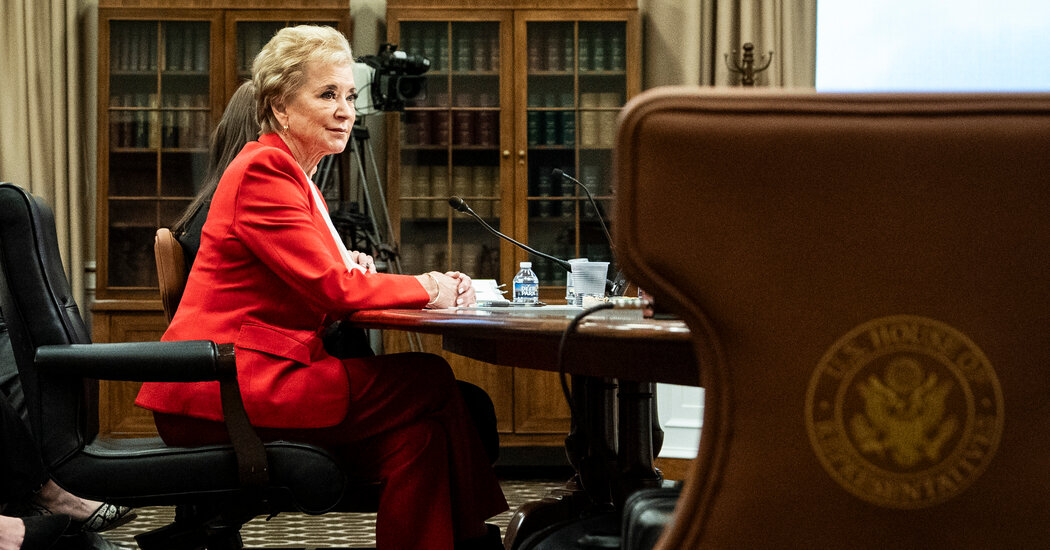
The White House is asking Congress to cut the number of lawyers enforcing civil rights in schools. Education Secretary Linda McMahon has told Congress she wants money to hire more.
Two White House officials, speaking on the condition of anonymity to discuss conflicting opinions within the administration, told The New York Times that the West Wing did not view the proposed budget as a starting point for negotiations with Congress, as Ms. McMahon repeatedly described it in congressional budget hearings.
“It is a floor for hiring,” Ms. McMahon told House lawmakers last week about proposed cuts to the Office for Civil Rights. “We want to increase those numbers.”
White House officials said they expected Ms. McMahon to work within the proposed budget, which would slash staffing at the civil rights office by 49 percent, from 530 to 271.
Public disagreements are rare between the White House and Cabinet officials, who are nominated for their jobs by the president. The incongruity over the education budget reflects the chaotic approach the Trump administration has taken toward civil rights enforcement in schools as it attempts to both shut down the Education Department and deploy its lawyers to tear down diversity initiatives and protections for transgender students.
Rachel Cauley, communications director for the White House Office of Management and Budget, blamed the inconsistency on “leftist judges” who blocked the administration’s attempt last year to carry out a mass firing of civil rights lawyers at the Education Department. “The president’s budget continues the promise of winding down the education bureaucracy in Washington, and Secretary McMahon has done a great job executing this vision,” she said.
Civil rights enforcement has been a central role of the Education Department for decades. The office investigates complaints from parents and others that schools have illegally discriminated against students on the basis of race, gender and other characteristics, and settles claims with school districts. Historically, a large proportion of these cases have been filed on behalf of disabled students.
Internal data show a sharp drop-off in the handling of students’ discrimination cases under President Trump. The Education Department processed 30 percent fewer civil rights complaints last year compared to the previous year, the steepest year-to-year decline in more than three decades, according to government data obtained by The New York Times.
When Ms. McMahon took over the department last year, she urged staff members to join her on a “final mission” to fulfill a decades-old Republican goal to close the Education Department. But the department cannot be shuttered without an act of Congress, and Republicans in control of the House and Senate have not made any moves in that direction.
In December, Ms. McMahon gave up on the firings in the face of mounting legal challenges and an expanding backlog of discrimination complaints in schools. A report from the Government Accountability Office showed the department spent as much as $38 million of its civil rights budget on lawyers whom they barred from working during the legal dispute.
Ms. McMahon told senators during a budget hearing in April that all of the civil rights lawyers had returned except for those who took early retirement. But public records suggest that Ms. McMahon has so far been unable to rebuild the office.
Congress has authorized money for the Education Department to hire 530 lawyers in its civil rights office. As of March, there were only 303 lawyers on the department’s entire payroll.
Job postings show the Education Department is seeking to hire lawyers for positions as civil rights enforcement directors, supervisory roles and “many vacancies” at regional offices in Atlanta, Denver, Kansas City, Seattle and Washington, D.C.
Savannah Newhouse, a spokeswoman for the Education Department, said the agency would “use all congressionally appropriated funds responsibly to uphold and restore civil rights enforcement to the letter of the law.”
“The president’s budget request for O.C.R. reflects the staffing number E.D. estimates it would need to meet all statutory requirements,” Ms. Newhouse said.
Democratic and Republican lawmakers have voiced concerns about the department’s handling of civil rights enforcement.
During Ms. McMahon’s confirmation hearing, Senator Bill Cassidy, the Republican chairman of the Senate education committee, asked if she had a plan to tackle a buildup of discrimination complaints. She said she would “clear out that backlog.”
On her eighth day on the job, however, she fired half of the department’s civil rights lawyers.
She told lawmakers last year the cuts had been proposed by Elon Musk’s team, known as the Department of Government Efficiency.
“They had started that process before I came on board,” Ms. McMahon told House lawmakers again last week.
At a Senate hearing on April 28, Ms. McMahon argued with Senator Chris Murphy, Democrat of Connecticut, that the Trump budget request for the civil rights office was a cut at all. Later in the hearing, she retreated slightly, saying that “hopefully we’ll have the ability to increase that.”
Ms. McMahon refused to answer directly when Representative Mark Takano, a California Democrat, asked last week if she was “disagreeing with the president’s budget.”
“The budget we submitted is a floor,” she said.